


Food and beverage manufacturers are routinely asked to expand production capacity under significant time and cost pressure, whether to support a successful new product or to honor strategic customer commitments. Existing facilities may need to be modernized while maintaining safe, reliable operations. In each case, leadership may begin with the obvious questions: How much will it cost? How quickly can it be built? Who will design it, and who will manage construction?
Those questions matter, but they do not go far enough. Before a manufacturer chooses between design-bid-build, design-build, progressive design-build, EPC, EPCM, or another delivery model, they need to understand how each approach functions. Contracting methodology determines how decisions are made, how risk is assigned, how quickly design and construction can move, how much owner involvement is required, and who is responsible when separate systems need to function as one facility through startup.
In food and beverage environments, a project typically includes hygienic process systems, packaging lines, utilities, wastewater handling, HVAC, controlled access, traffic flow, sanitary zoning, and commissioning activities that all need to converge around a startup plan. The right delivery model will not guarantee success on its own, but the wrong fit can make an already difficult project harder to coordinate, price, and bring online.

The Delivery Model Should Follow the Project, Not the Other Way Around
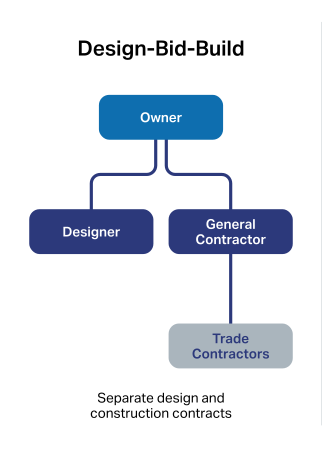
Each contracting methodology creates a different relationship between the owner, designer, builder, engineers, equipment suppliers, and subcontractors. In a traditional design-bid-build model, the owner typically holds separate contracts for design and construction. The design is developed first, then bid, then built. This approach can give the owner more direct control, but it also requires the owner to manage the gaps between parties. Because design generally must be substantially complete before the work can be competitively bid and awarded, design, procurement, and construction tend to proceed in sequence rather than in parallel. That linear progression can extend the overall delivery schedule and limits the team’s ability to procure long-lead equipment, incorporate contractor constructability input, or begin selected field activities while detailed design continues.
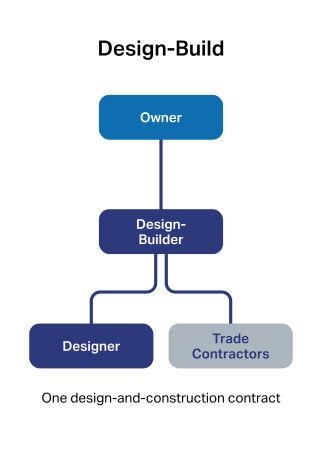
Design-build consolidates more responsibility under one entity. Instead of managing separate design and construction contracts, the owner works with a single design-build lead that coordinates both efforts. This can reduce handoffs, streamline communication, and allow design, procurement planning, and selected construction activities to overlap, accommodating more aggressive timelines and faster speed to market.
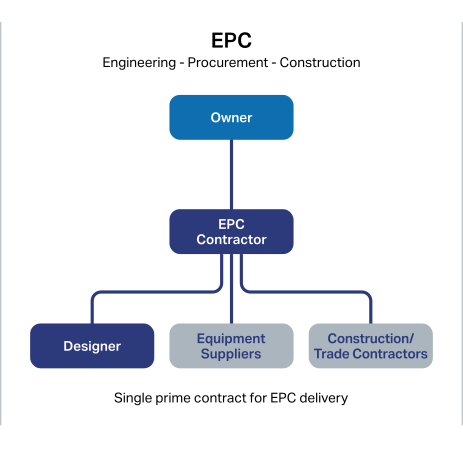
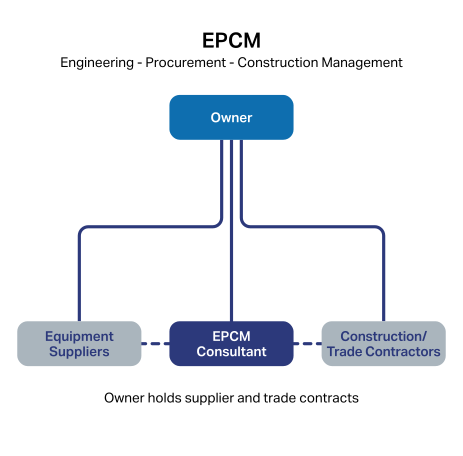
EPC, or engineering, procurement, and construction, is often associated with more turnkey delivery. One contractor takes responsibility for engineering, procurement, and construction, usually with a high level of accountability for scope, cost, schedule and performance. EPCM, or engineering, procurement, and construction management, is different. Under EPCM, the provider acts more as a professional services partner or owner’s representative, helping to engineer the project, procure equipment and services, and manage construction contractors. The owner often still holds more of the direct contractual risk and decision making burden.
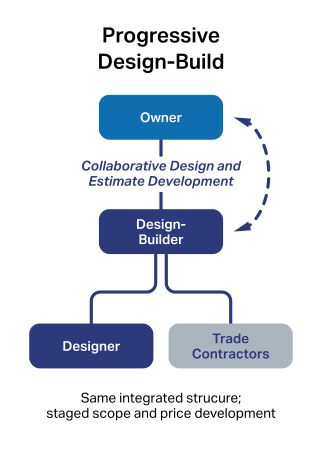
In practice, the boundaries between EPC and EPCM can blur, and terms like “owner’s agent” or “integrated project delivery” are often applied in ways that do not match their literal definitions on paper. The important point is that these terms are often used loosely. “Integrated project delivery,” “progressive design-build,” “owner’s agent,” “EPCM,” and “turnkey” can mean different things to different teams. Owners should be cautious about choosing a model by acronym. A better starting point is to define what the project actually needs, whether that be speed, cost certainty, flexibility, owner control, specialized expertise, limited internal burden, or some combination of these priorities. Contract terms can then be developed to best manage these specific project priorities.
Risk Transfer Has a Cost, and Some Risk Always Stays with the Owner
Owners often approach contracting methodology through the lens of risk transfer. They may want a guaranteed maximum price, schedule certainty, or a single party responsible for performance. These goals are understandable, but risk transfer is never free. The more risk an owner asks a contractor or design‑builder to carry, the more that risk is likely to reappear somewhere else in the project cost, contingency, fee structure, or change order process.
This is especially true when an owner tries to lock in maximum price certainty too early. If a fixed price or guaranteed maximum price is established while the design is still changing, the project team has to price uncertainty. That may mean elevated contingencies, conservative assumptions, exclusions, or a higher likelihood of change orders later.
Early price certainty can create the appearance of control while reducing flexibility and increasing the premium paid for unknowns. In many cases, owners can pay twice for that early certainty—once in the form of higher contingencies and again when scope evolution drives change orders that were inevitable given how immature the design still was.
Preserving flexibility too long can actually slow a project down. One of the key advantages of design-build and progressive models is that phases can overlap. While design is still being refined, the team can validate constructability, procure long-lead items, and begin selected construction activities. However, if the owner waits until late in design to establish a final price before releasing procurement packages or authorizing early construction activities, those activities can no longer proceed in parallel. The result can be a longer overall project schedule and the loss of one of the delivery model’s primary schedule advantages.
For complex food and beverage projects, many technical teams gravitate toward open‑book cost‑plus arrangements because they allow transparency, collaborative value decisions, and more surgical use of contingency rather than blanket premiums. Procurement and legal groups, however, may later push for firmer guarantees around cost or schedule using boilerplate positions that were never discussed with the initial project team. When those internal perspectives are not aligned early, owners can find themselves renegotiating risk mid‑stream, delaying awards and reshaping the project’s risk profile after major scoping decisions have already been made.
Owners also need to distinguish between risks that can be reasonably allocated through the contract and risks that remain primarily within the owner’s control. Cost and schedule risk can often be assigned in part, depending on the contract structure. The contract can also clarify responsibility when scope interpretation is unclear, when subcontractor performance falls short, or when defined schedule milestones are missed. However, operational startup risk remains deeply dependent on the owner. A project team can design and build a high-quality facility, but the owner must still develop and deliver staffing plans, trained operators, raw material readiness, logistics, sanitation procedures, quality systems, and production ramp up discipline.
This effort required for effectively planning and achieving a successful start-up curve in the food and beverage industry can often be underestimated. Substantial completion is not the same as a successful startup. A plant may be mechanically complete but still struggle if operators are not trained, materials are not staged, commissioning is rushed, or the phased startup sequence is poorly coordinated. The delivery model can support startup, but it cannot replace the owner’s operational preparation.
Food and Beverage Projects Break Down at the Interfaces
Many contracting problems show up as coordination problems first—a packaging line cannot be installed because the floor coating is not ready, utility readiness lags behind process equipment installation, or wastewater systems are not prepared for trial production, for example. Mechanical checks, I/O checks, commissioning runs, sanitation validation, and operational training all depend on smaller milestones that may not be obvious in a high level schedule.
In a fragmented model, the owner often becomes the project glue. Separate designers, contractors, process suppliers, equipment vendors, and trade partners may each be performing their scope correctly, but no single party may be accountable for making sure every interface works as a system. That burden can be manageable for an owner with a large internal engineering, procurement, project controls, and construction management team. For many manufacturers, however, the project is being managed by people who also have demanding day jobs.
This challenge becomes more pronounced in brownfield expansions and retrofits. Existing utilities may not be well documented. Production must continue around construction. Operational stakeholders such as quality, EHS, sanitation, logistics, maintenance, and plant leadership need to provide input, but they may not have time to participate deeply in planning sessions. Hidden constraints can often be reduced through diligence, but only if the project team gets access to the right information and the right people early enough.
Facility-wide planning connects receiving, production, packaging, and storage so separate project scopes can function as one operation.

Hygienic design adds another layer of coordination. Food and beverage facilities need to consider more than equipment layout. A strong front‑end plan should establish a hygienic zoning strategy that examines material flow, people flow, air balance, wastewater and drainage routing, access control, high‑care, medium‑care, and low‑care zones, HVAC filtration, waste handling, and site conditions that may introduce contamination vectors. These details affect facility design, process design, construction sequencing, and startup. When they are handled in disconnected pieces, small misses can become costly late stage corrections.
Solid Planning is the Best Defense
Before issuing an RFP, owners should spend more time defining success. This does not mean every detail needs to be engineered before a project partner is selected; but it does mean the leadership team should have a clear view of production needs, capacity targets, SKU requirements, packaging expectations, ingredient receiving methods, utility demands, site constraints, materials of construction, sanitation expectations, and operational startup requirements.
This front-end work may be called project definition, master planning, conceptual engineering, feasibility planning, or FEL planning. Regardless of terminology, its purpose is the same: to create enough shared understanding that the owner can choose a delivery model based on the project’s actual needs rather than a default procurement habit.
A project charter can be especially valuable. It should define what success looks like, who needs to be involved in decisions, which priorities matter most, and where the owner is willing to trade flexibility for certainty or certainty for speed. Without that alignment, even the right contracting methodology can struggle. Decision churn is often an early warning sign. When teams revisit the same decisions repeatedly, it usually means the right information, decision makers, or accountability structure is missing.
This is also the stage where engineering, operations, procurement, and legal teams need to be aligned. A technical team may favor an open book cost-plus approach because it allows transparency, collaboration, and value-based decisions. Procurement or legal teams may later push for more guarantees around cost or schedule. Neither perspective is wrong, but disconnects late in negotiation can delay the project and change the risk profile after the scope has already been shaped around a different assumption.
The strongest approach is to let the project reveal the model. A straightforward greenfield facility with a well defined scope and a small owner team may benefit from design-build. A complex brownfield expansion with ongoing operations, tight interfaces, and a need for value engineering may point toward progressive design-build. An owner with significant internal resources and a desire to retain more direct control may consider EPCM, understanding that this also requires more active day‑to‑day management of contractors. A highly defined project with a clear appetite for turnkey responsibility may fit EPC. The right answer depends less on the label and more on the match between project complexity, owner capability, desired control, and risk tolerance.

The best contracting decisions are made before the RFP, when project goals, internal capacity, and risk tolerance can still be aligned.
Choosing a Partner That Matches the Complexity of Your Project
For food and beverage manufacturers, the delivery model is only part of the decision. The project partner’s capabilities matter just as much. A design-build project can still feel fragmented if the team behaves transactionally or lacks the internal expertise to coordinate the process and understand the specific needs of the food and beverage industry. Conversely, a less than perfect methodology can succeed when the team communicates well, understands the owner’s operation, and manages interfaces with discipline.
This is where integrated expertise becomes valuable. Dennis Group, a leading design-build firm dedicated exclusively to the food and beverage industry, offers an approach that reflects many of the principles that make complex food and beverage projects more manageable: rigorous front‑end project definition, single‑source accountability for design, construction, and startup, full‑service delivery capabilities, and an industry-specific understanding of how production needs drive facility and site decisions. Drawing on in‑house capabilities in process design, packaging systems, controls and automation, modeling, refrigeration, wastewater, site planning, hygienic design, construction, commissioning, and operational startup, Dennis Group helps owners connect decisions that are often separated across multiple firms. The same discipline leads who help shape the conceptual design continue to be involved in detailed engineering, field coordination, and startup, so early assumptions are tested and refined by the people who will live with them in the field. A manufacturer expanding capacity does not need a delivery model that looks clean only on paper; it needs a structure and a partner that can carry the project from early planning through construction, commissioning, startup, and long‑term operational performance. The same assumptions that shape early planning will eventually impact procurement, installation, sanitary design, and ramp up.
Successful project delivery depends on more than construction completion; the facility must be ready to operate, ramp up, and support long term production goals.

Ultimately, the question is not whether design-build is better than design-bid-build, or whether EPCM is better than progressive design-build. The better question is what the project will demand from the owner and its partners. How much internal bandwidth does the owner truly have? How much uncertainty remains in the scope? How important is speed to market? Which risks can be priced, and which must be actively managed?
A contracting methodology should make those answers clearer, not hide them behind an acronym. When owners choose a model based on project realities, internal capabilities, and the level of accountability required, they give themselves a better chance of delivering more than a mechanically complete facility. They create the conditions for a hygienic, compliant plant that can start up, scale, and perform as intended over its full life cycle.
Author

Mary Frances Stotler


 English
 Português do Brasil
 Español de México